Kitravia
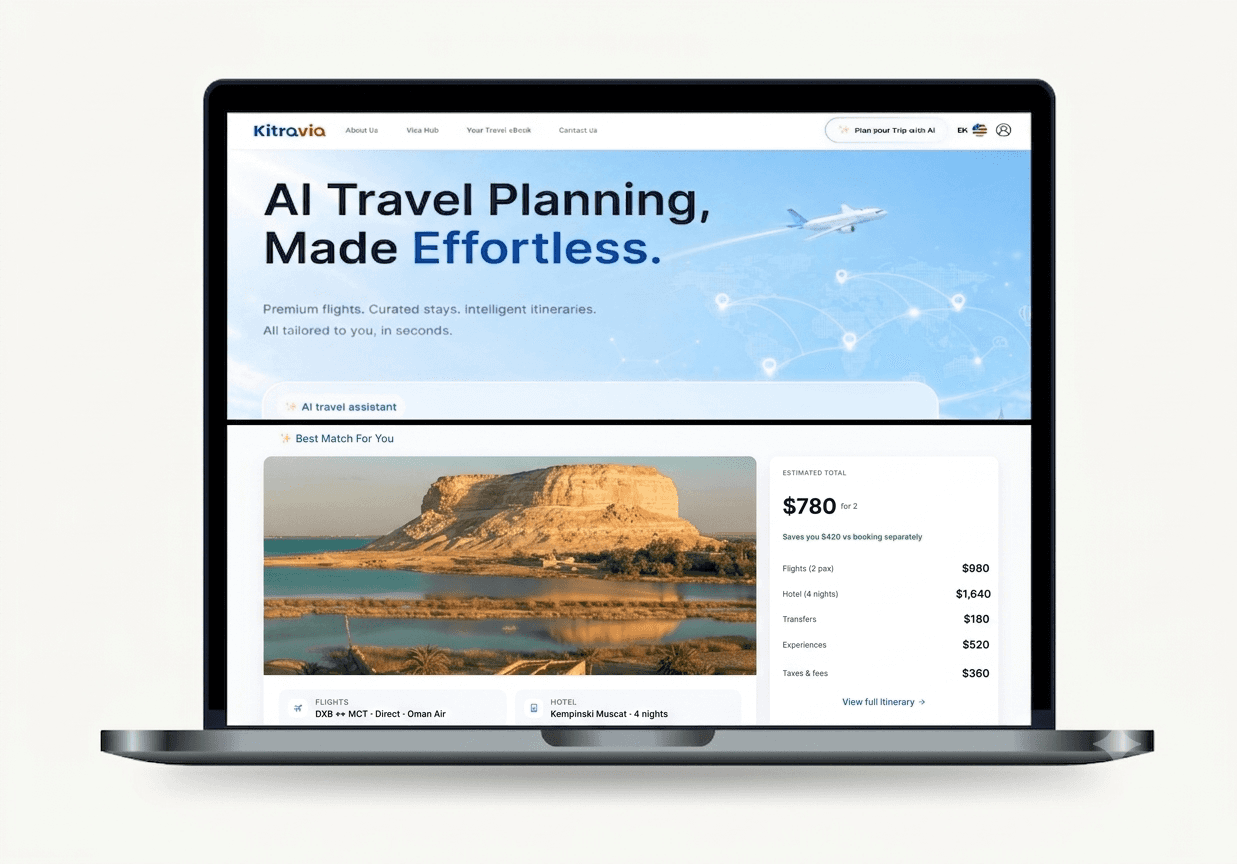
Kitravia reimagines travel booking as a guided, AI-assisted conversation, transforming fragmented multi-tab searching into a faster, clearer, and more trustworthy end-to-end experience.

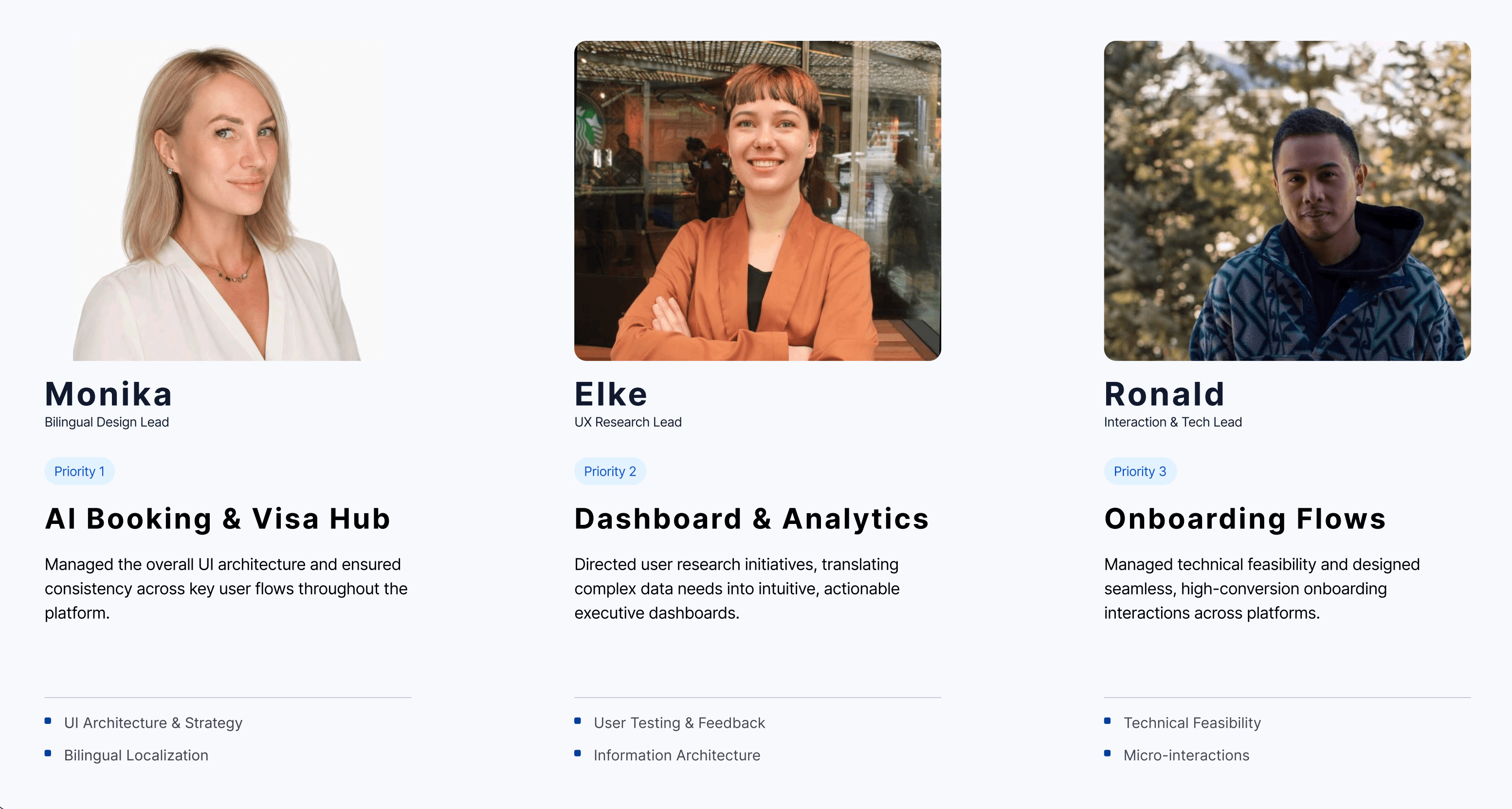
Role: UX/UI Design (team of three) — owned the B2C flow: AI search, results, booking flow, and visa hub.
Scope: End-to-end redesign of an AI-powered, conversational travel booking experience, from wireframes to developer-ready responsive design.
Goal: Replace fragmented, form-heavy booking with a guided AI concierge experience, targeting a 40 percent reduction in booking time.
Outcome: Research led to a Review & Confirm checkpoint, stronger visual hierarchy, and a simplified mobile-first flow — creating a trustworthy, scalable AI travel experience.
Competitive Landscape
To validate this positioning, a detailed competitive analysis was conducted across six direct and adjacent platforms — Kayak, Google Flights, Airbnb, Booking.com, and Expedia — comparing how each defines itself, who it serves, and which features drive retention. The analysis confirmed that while competitors solve narrow versions of the same problem — search speed, price tracking, or curated stays — none combine conversational AI planning with end-to-end booking and trust-building features the way Kitravia was positioned to.

Role and Scope
The redesign was completed in a team of three. Within that team, the design lead owned the primary B2C flow, including conversational AI search, search results, the five-step booking flow, and the visa booking hub.
The scope went beyond visual cleanup. It required reshaping information architecture, interaction patterns, trust moments, and mobile-first entry points so the product felt understandable on first contact and scalable enough for handoff to development.
Project Plan
The project followed a structured team process across defined phases — generative research, synthesis, ideation, wireframing, prototyping, and usability testing — with clear ownership split across the three-person team and fixed checkpoints for review and iteration. Working from a shared project plan kept the B2C flow aligned with the visa hub and the broader platform, even though each team member owned a different part of the experience.

Goals
The redesign aimed to replace a manual, multi-tab booking process with an intelligent concierge-style experience. A key project objective was a projected 40 percent reduction in average booking time through a more guided and conversational flow.
From a UX perspective, the goals were more specific:
Reduce cognitive load during search and decision-making.
Make the AI interaction feel understandable rather than opaque.
Preserve user confidence through explicit review and confirmation moments.
Improve mobile first impressions by surfacing the main action immediately.
Create a developer-ready system that could scale across responsive layouts and bilingual content.
Interview Insights
Across all six sessions, booking behavior turned out to be multi-platform by default — every participant used more than one platform or source per session, with an average of two to four tabs open, which created doubt rather than confidence even after booking. Standard filters also failed for complex needs, forcing users like Alex to manually keyword-search reviews for family-specific requirements such as kids' clubs or diving. Trust in AI emerged as conditional rather than binary: every participant welcomed AI assistance but rejected one-click autonomous booking, and several explicitly wanted a conversational interface over pre-set prompt tags.

Opportunity Map
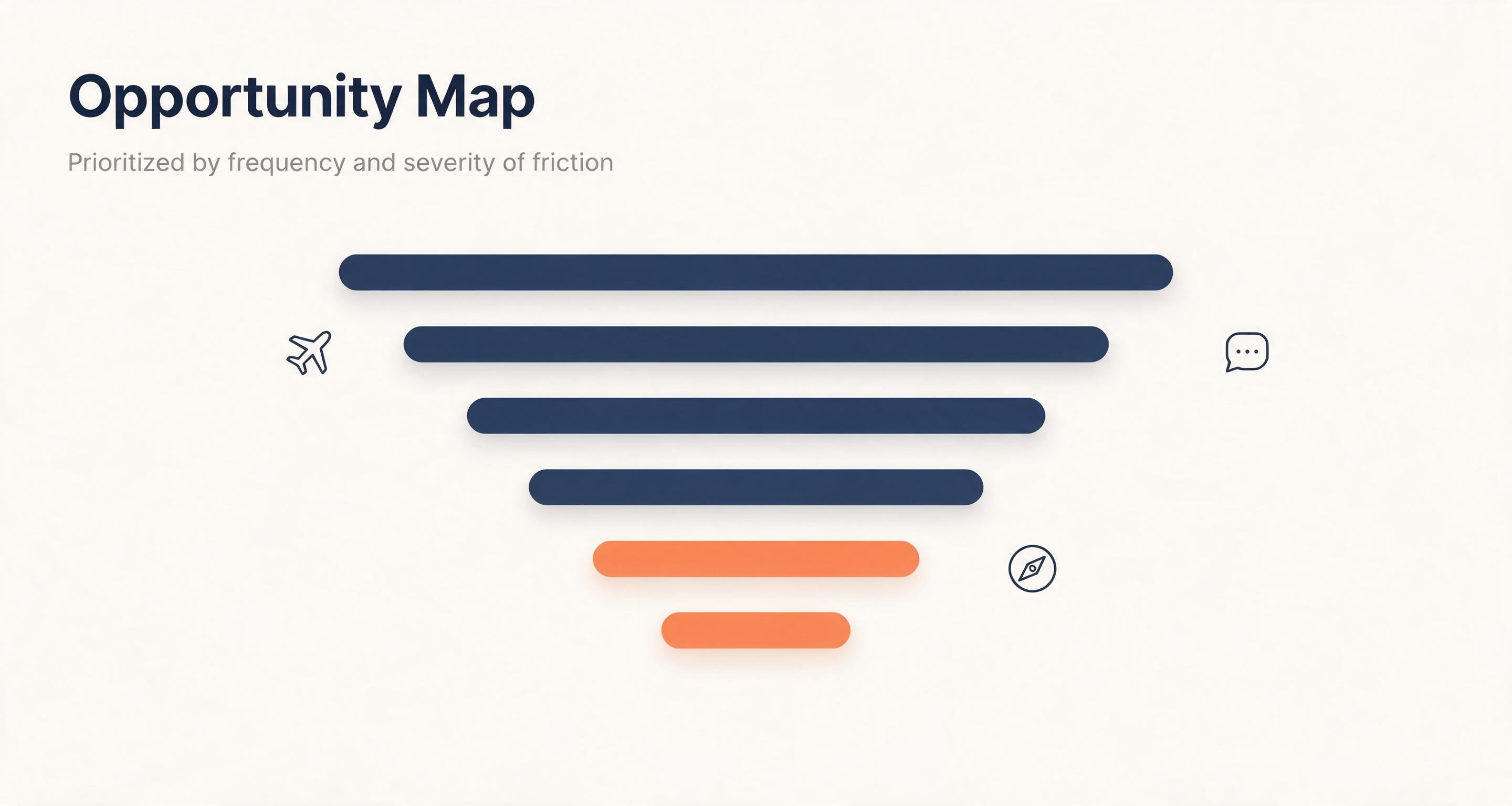
The interview findings were translated into a ranked opportunity map, prioritizing needs by frequency of mention and severity of friction. The two highest-ranked opportunities — a unified trip planning hub to eliminate tab-switching, and transparent AI decision gates before any financial transaction — directly shaped the two most important design decisions in the final product: the consolidated booking flow and the mandatory Review & Confirm checkpoint.

Key Insights
The research produced several important insights that shaped the redesign:
Users need fast orientation before they need detail.
Clear grouping matters more than adding more content blocks.
Stronger hierarchy can improve usability without making the interface feel visually heavy.
Users want AI support, but not full AI control over booking and payment.
Trust is built through reviews, comparison, transparent pricing, and visible confirmation steps.
Mobile hierarchy is critical, because the main action must be visible immediately.
These insights became the backbone of the final experience. They pushed the design toward a cleaner structure, simpler navigation, stronger visual hierarchy, and a more disciplined booking flow.


Wireframe Evolution
Lo-fi wireframes helped validate the structure before visual polish. They let the team test hierarchy, flow, and decision points early, before moving into hi-fi design.

Usability Testing
Three moderated usability sessions were conducted on the Kitravia prototype, covering the homepage, AI trip search, flight and hotel selection, checkout flow, and the Visa Hub, using a think-aloud method with participants representing marketing, product strategy, and frequent-traveler perspectives. The concept resonated clearly, but the experience still felt closer to a traditional travel search tool than to a true AI agent, which became the single most important finding of the study.
Testing surfaced five prioritized issues: AI was not visually dominant enough to support its own value proposition, users expected curated recommendations rather than filtered lists, the flow had hierarchy and sequencing problems, the visual system lacked the consistency needed for a premium AI positioning, and the email capture popup interrupted the journey at the wrong moment. The Visa Hub was seen as a genuinely differentiating feature, though first-time users needed more framing before starting the flow.

What changed
One of the most important changes was introducing a mandatory Review & Confirm checkpoint. Testing showed that users felt anxious when AI appeared to take full control during checkout or disruption scenarios, so the flow needed a clear moment for human approval.
The visual hierarchy was also strengthened across the entire booking journey. Instead of allowing every step to compete for attention, the redesigned flow guides users more clearly through the process, reducing confusion and making the experience feel more controlled.
The mobile homepage was simplified so the chat prompt could act as the primary above-the-fold action. This was not a cosmetic change — it directly addressed the first-impression problem identified during research.


Final Design
Kitravia translated AI-assisted travel into a clearer, more trustworthy booking experience by combining conversational search, structured results, two booking flows, and a guided visa hub within one coherent system.
Rather than automating decisions away from the user, the design used speed, transparency, and clear confirmation points to make complex travel planning feel simpler, more credible, and easier to act on.
Outcome
Delivering the Kitravia project was a masterclass in balancing cutting-edge technology with the fundamental human need for trust and control. By shifting from a traditional, form-heavy interface to an intuitive, conversational AI model, the team established a design foundation projected to reduce average booking time by 40 percent.
Even without full production metrics, the case shows mature UX thinking grounded in evidence: a clearly mapped opportunity space, a tested prototype, and design decisions that trace directly back to specific user findings rather than assumptions.
Reflection
Beyond the metrics, leading the B2C flow for a bilingual, global platform reinforced a core design philosophy. It proved that true innovation is not just about implementing the latest AI features; it is about crafting digital journeys that translate complex, overwhelming data into an effortless, accessible, and deeply human experience.
