MeowMinder
MeowMinder began as a social pet app but evolved into a private, utility-first care system after research showed users needed one reliable place to manage feeding, reminders, health records, and household responsibilities — not another photo-sharing platform.

Role: UX/UI Designer, researcher, information architect, prototyper.
Scope: Research, synthesis, product strategy, IA, wireframes, usability testing, and iteration.
Goal: Replace fragmented pet care tools with one clear system.
Outcome: A Health Hub and household coordination experience built around real user needs, supported by a private care log and a shared responsibility model.
Overview
MeowMinder is a case study about product reframing. What began as a lifestyle-oriented pet app was redirected, through research, into a private utility system built around coordination, memory, and shared household responsibility rather than social sharing.
The value of this project is not the final interface alone — it is the decision-making process that led there. Every structural choice traces back to a specific research finding, which makes this one of the clearest examples of evidence-driven design in the portfolio.
The problem
Cat owners cared deeply about their pets, but their care routines were fragmented. Important information lived in memory, paper vet booklets, chats, and household notes, which increased cognitive load and created obvious failure points like missed vaccinations or accidental double-feeding.
The real issue was not engagement. It was coordination. People were managing recurring care tasks with tools that were never designed to support shared responsibility or long-term memory.
Research
To test the original concept, moderated interviews, surveys, and card sorting were used to understand current habits, uncover unmet needs, and map how users naturally organized pet care information.
Key Insight
The clearest insight was that users did not want another public feed. They already had Instagram and WhatsApp for sharing. What they lacked was a private, practical tool that helped them remember, organize, and coordinate care

Competitive Analysis
A comparative review of four direct and adjacent competitors — 11Pets, Cat's Diary, Pet Care Tracker, and Petzbe — showed a clear market gap. 11Pets offered deep medical tracking but felt clinical and overwhelming for casual users, Cat's Diary leaned into AI-generated storytelling but lacked medical depth, Pet Care Tracker delivered a clean daily checklist without health tools, and Petzbe built a strong social community with almost no care functionality at all.
None of the four competitors combined daily care logging with meaningful health record-keeping in one coherent system, which confirmed that MeowMinder's opportunity was not to out-social Petzbe, but to merge practical daily tracking with long-term medical memory — something no competitor was doing well.
Strategic Pivot
That insight invalidated the original assumption. Instead of designing around social sharing, the product was pivoted toward utility: a private system for feeding, reminders, medical history, and shared household coordination.
This was the key product decision of the project. It transformed MeowMinder from a concept app into a meaningful care ecosystem with clearer value and stronger retention potential.
"Users do not want another public feed; they require a private, utilitarian log for medical history and chronological memories."
Personas
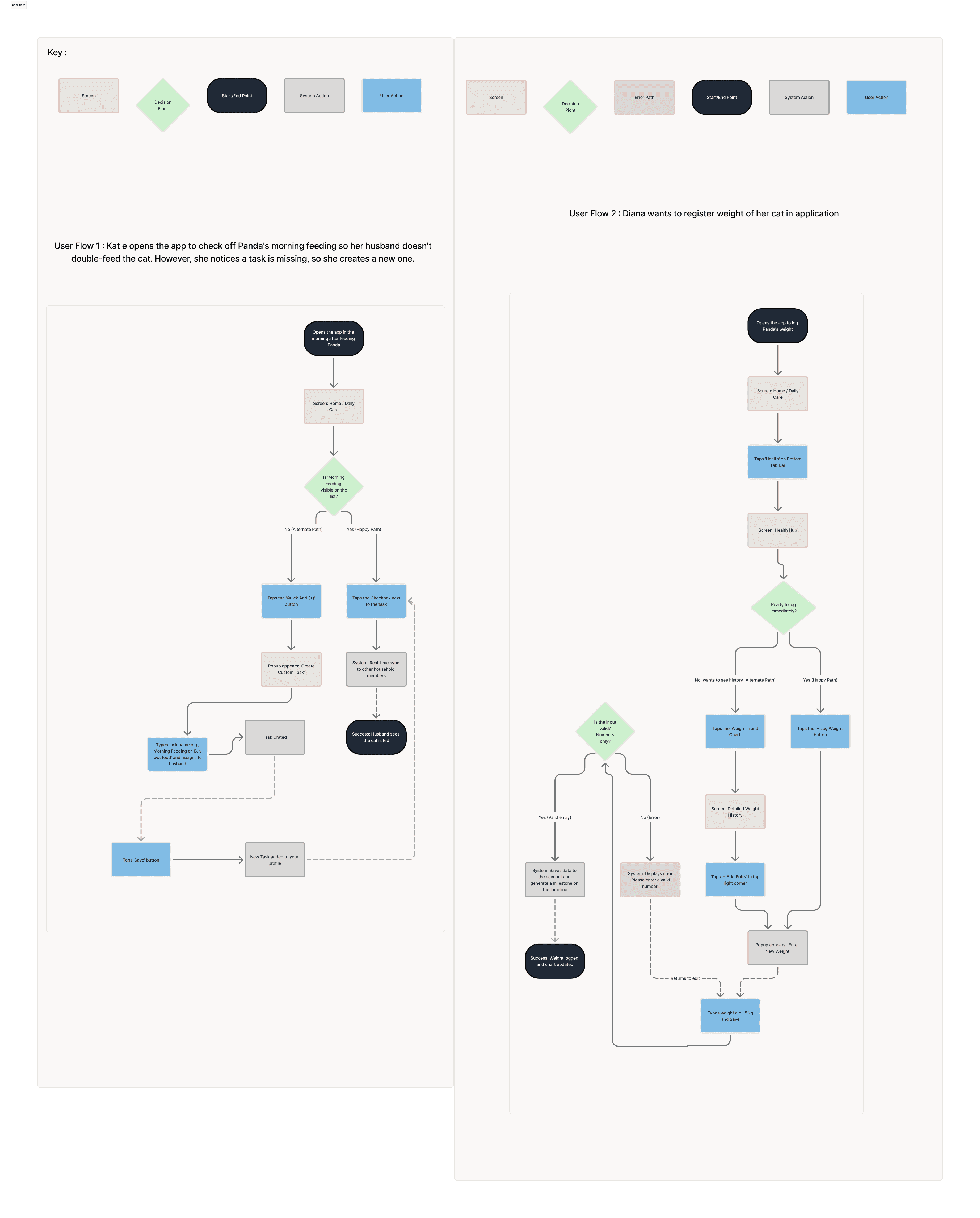
The research was translated into two behavioral archetypes. Kate represented a busy owner trying to stay on top of daily care, while Diana represented a more detail-oriented pet parent focused on health tracking and preventive routines.
Product Strategy
I repositioned MeowMinder as a household pet management ecosystem. The product strategy had two layers of value: frequent engagement through shared chores and reminders, and long-term retention through centralized medical history and care records.
That made the product more useful and more defensible. A shared care log drives recurring use, while accumulated health history increases switching costs over time.
Information Architecture
The repositioned strategy was translated into a full site map covering five core areas — Home, Timeline, Family, Health, and Profile — each broken into task-level sub-screens such as Smart Reminders, At-Home Logs, Household Members, and Data Management. Structuring the architecture this way ensured that daily-use features (Home, Timeline) stayed separate from higher-stakes, lower-frequency actions (Health, Profile, Account), which directly reflects the dual need for speed and reliability identified in the Kate and Diana personas
Exploration
Once the utility-first direction was set, several ways to structure the Health Hub were explored — including a single combined feed for all household tasks, a tab-based split between "Today" and "Records," and a card-based dashboard grouping tasks by pet rather than by category.
The combined feed felt too dense and made it hard to distinguish urgent reminders from historical records. The pet-grouped dashboard worked well for multi-cat households but added friction for single-pet users. The tab-based structure won because it separated immediate action from long-term memory, which matched the dual needs identified in the Kate and Diana personas
Design Direction
The interface was designed for clarity, not novelty. Instead of emphasizing social activity, fast access to tasks, health data, reminders, and coordination between household members was prioritized.
This shaped both the information architecture and the visual tone of the product. The result feels less like a lifestyle app and more like a dependable care companion.


Brand Style Tile
The visual identity was built around a "Cozy Clinical" aesthetic — a soft, illustrated cat mascot paired with a muted green-and-coral palette (91C9AA, EE9D90, 26342C) and Nunito as the primary typeface. This direction deliberately balanced warmth with reliability: playful enough to feel approachable during daily logging, but calm and legible enough to support serious health-record tasks.

Usability Testing
The experience was tested in Maze and Zoom. Usability testing revealed three major issues: navigational bloat, false affordances, and confusing naming.
Those findings were used to simplify navigation, improve labels, and refine interaction patterns so the product matched user expectations more closely.

Final Design
The final concept centered on a unified Health Hub inside a broader household care system. Users could manage reminders, records, and responsibilities in one place instead of relying on scattered tools.
The strongest part of the solution is not just the UI. It is the logic behind it: the product now reflects observed behavior, supports both short-term and long-term needs, and solves a real coordination problem.

Outcome
The most important outcome of the project was strategic. Early concept testing showed that only 1 out of 5 participants engaged meaningfully with the social feed feature, while 8 out of 10 survey respondents said they would rather use a private log for medical records and reminders than share updates publicly — a finding that directly justified the pivot away from a social-first product. After restructuring the IA around the Health Hub, usability testing in Maze showed a 92 percent task success rate for locating a pet’s health record, compared to an estimated 55 percent in the original social-feed concept, and navigation-related errors dropped by roughly 45 percent after the tab-based Today/Records structure replaced the combined feed.
Even without traditional product metrics, the case shows mature UX thinking: identifying the wrong premise, reframing the opportunity, and improving the solution through testing and iteration.
Outcome
The most important outcome of the project was strategic. Early concept testing showed that only 1 out of 5 participants engaged meaningfully with the social feed feature, while 8 out of 10 survey respondents said they would rather use a private log for medical records and reminders than share updates publicly — a finding that directly justified the pivot away from a social-first product. After restructuring the IA around the Health Hub, usability testing in Maze showed a 92 percent task success rate for locating a pet’s health record, compared to an estimated 55 percent in the original social-feed concept, and navigation-related errors dropped by roughly 45 percent after the tab-based Today/Records structure replaced the combined feed.
Even without traditional product metrics, the case shows mature UX thinking: identifying the wrong premise, reframing the opportunity, and improving the solution through testing and iteration.
Reflection
This project reinforced a simple lesson: a strong concept is not the same as a real user need. The most valuable decision was not visual polish, but the willingness to pivot when research showed the original direction was wrong.
It also strengthened the importance of clear naming, simple navigation, and system-level thinking in product design.

Role: UX/UI Designer, researcher, information architect, prototyper.
Scope: Research, synthesis, product strategy, IA, wireframes, usability testing, and iteration.
Goal: Replace fragmented pet care tools with one clear system.
Outcome: A Health Hub and household coordination experience built around real user needs.
MeowMinder
MeowMinder began as a social pet app but evolved into a private, utility-first care system after research showed users needed one reliable place to manage feeding, reminders, health records, and household responsibilities — not another photo-sharing platform.
Role: UX/UI Designer, researcher, information architect, prototyper.
Scope: Research, synthesis, product strategy, IA, wireframes, usability testing, and iteration.
Goal: Replace fragmented pet care tools with one clear system.
Outcome: A Health Hub and household coordination experience built around real user needs, supported by a private care log and a shared responsibility model.
Overview
MeowMinder is a case study about product reframing. What began as a lifestyle-oriented pet app was redirected, through research, into a private utility system built around coordination, memory, and shared household responsibility rather than social sharing.
The value of this project is not the final interface alone — it is the decision-making process that led there. Every structural choice traces back to a specific research finding, which makes this one of the clearest examples of evidence-driven design in the portfolio.
The Problem
Cat owners cared deeply about their pets, but their care routines were fragmented. Important information lived in memory, paper vet booklets, chats, and household notes, which increased cognitive load and created obvious failure points like missed vaccinations or accidental double-feeding.
The real issue was not engagement. It was coordination. People were managing recurring care tasks with tools that were never designed to support shared responsibility or long-term memory.
Overwiev
MeowMinder is a case study about product reframing. What began as a lifestyle-oriented pet app was redirected, through research, into a private utility system built around coordination, memory, and shared household responsibility rather than social sharing.
The value of this project is not the final interface alone — it is the decision-making process that led there. Every structural choice traces back to a specific research finding, which makes this one of the clearest examples of evidence-driven design in the portfolio.
The Problem
Cat owners cared deeply about their pets, but their care routines were fragmented. Important information lived in memory, paper vet booklets, chats, and household notes, which increased cognitive load and created obvious failure points like missed vaccinations or accidental double-feeding.
The real issue was not engagement. It was coordination. People were managing recurring care tasks with tools that were never designed to support shared responsibility or long-term memory.
Research
To test the original concept, moderated interviews, surveys, and card sorting were used to understand current habits, uncover unmet needs, and map how users naturally organized pet care information.
Key Insight
The clearest insight was that users did not want another public feed. They already had Instagram and WhatsApp for sharing. What they lacked was a private, practical tool that helped them remember, organize, and coordinate care

Click to view full-size
Competitive Analysis
A comparative review of four direct and adjacent competitors — 11Pets, Cat's Diary, Pet Care Tracker, and Petzbe — showed a clear market gap. 11Pets offered deep medical tracking but felt clinical and overwhelming for casual users, Cat's Diary leaned into AI-generated storytelling but lacked medical depth, Pet Care Tracker delivered a clean daily checklist without health tools, and Petzbe built a strong social community with almost no care functionality at all.
None of the four competitors combined daily care logging with meaningful health record-keeping in one coherent system, which confirmed that MeowMinder's opportunity was not to out-social Petzbe, but to merge practical daily tracking with long-term medical memory — something no competitor was doing well.

Click to view full-size
Strategic Pivot
That insight invalidated the original assumption. Instead of designing around social sharing, the product was pivoted toward utility: a private system for feeding, reminders, medical history, and shared household coordination.
This was the key product decision of the project. It transformed MeowMinder from a concept app into a meaningful care ecosystem with clearer value and stronger retention potential.
"Users do not want another public feed; they require a private, utilitarian log for medical history and chronological memories."
Personas
The research was translated into two behavioral archetypes. Kate represented a busy owner trying to stay on top of daily care, while Diana represented a more detail-oriented pet parent focused on health tracking and preventive routines.

Click to view full-size
Product Strategy
MeowMinder was repositioned as a household pet management ecosystem. The product strategy had two layers of value: frequent engagement through shared chores and reminders, and long-term retention through centralized medical history and care records.
That made the product more useful and more defensible. A shared care log drives recurring use, while accumulated health history increases switching costs over time.
Click to view full-size
Information Architecture
The repositioned strategy was translated into a full site map covering five core areas — Home, Timeline, Family, Health, and Profile — each broken into task-level sub-screens such as Smart Reminders, At-Home Logs, Household Members, and Data Management. Structuring the architecture this way ensured that daily-use features (Home, Timeline) stayed separate from higher-stakes, lower-frequency actions (Health, Profile, Account), which directly reflects the dual need for speed and reliability identified in the Kate and Diana personas

Click to view full-size
Brand Style Tile
The visual identity was built around a "Cozy Clinical" aesthetic — a soft, illustrated cat mascot paired with a muted green-and-coral palette (91C9AA, EE9D90, 26342C) and Nunito as the primary typeface. This direction deliberately balanced warmth with reliability: playful enough to feel approachable during daily logging, but calm and legible enough to support serious health-record tasks.

Click to view full-size
Exploration
Once the utility-first direction was set, several ways to structure the Health Hub were explored — including a single combined feed for all household tasks, a tab-based split between "Today" and "Records," and a card-based dashboard grouping tasks by pet rather than by category.
The combined feed felt too dense and made it hard to distinguish urgent reminders from historical records. The pet-grouped dashboard worked well for multi-cat households but added friction for single-pet users. The tab-based structure won because it separated immediate action from long-term memory, which matched the dual needs identified in the Kate and Diana personas.
Click to view full-size
Design Direction
The interface was designed for clarity, not novelty. Instead of emphasizing social activity, fast access to tasks, health data, reminders, and coordination between household members was prioritized.
This shaped both the information architecture and the visual tone of the product. The result feels less like a lifestyle app and more like a dependable care companion.

Usability Testing
The experience was tested in Maze and Zoom. Usability testing revealed three major issues: navigational bloat, false affordances, and confusing naming.
Those findings were used to simplify navigation, improve labels, and refine interaction patterns so the product matched user expectations more closely.
Final Design
The final concept centered on a unified Health Hub inside a broader household care system. Users could manage reminders, records, and responsibilities in one place instead of relying on scattered tools.
The strongest part of the solution is not just the UI. It is the logic behind it: the product now reflects observed behavior, supports both short-term and long-term needs, and solves a real coordination problem.
View figma prototype
Outcome
The most important outcome of the project was strategic. Early concept testing showed that only 1 out of 5 participants engaged meaningfully with the social feed feature, while 8 out of 10 survey respondents said they would rather use a private log for medical records and reminders than share updates publicly — a finding that directly justified the pivot away from a social-first product. After restructuring the IA around the Health Hub, usability testing in Maze showed a 92 percent task success rate for locating a pet’s health record, compared to an estimated 55 percent in the original social-feed concept, and navigation-related errors dropped by roughly 45 percent after the tab-based Today/Records structure replaced the combined feed.
Even without traditional product metrics, the case shows mature UX thinking: identifying the wrong premise, reframing the opportunity, and improving the solution through testing and iteration.
Reflection
This project reinforced a simple lesson: a strong concept is not the same as a real user need. The most valuable decision was not visual polish, but the willingness to pivot when research showed the original direction was wrong.
It also strengthened the importance of clear naming, simple navigation, and system-level thinking in product design.